

Objectes multimèdia amb l’etiqueta: Mecànica de fluids
Resultats de la cerca
Particle Image Velocimetry
Accés obert
6 d’abr. 2011
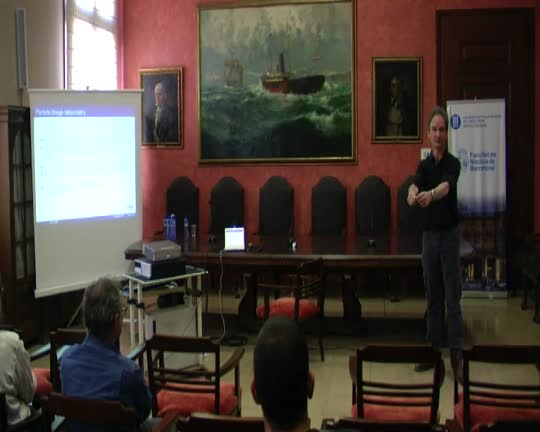
Conferència impartida a la sala de juntes de l'FNB pel professor Peter Bueken de l'Antwerp Maritime Academy (Bèlgica). "Chemical tankers often transport large amounts of toxic or dangerous products such as benzene, toluene, ... Exposure to these products presents a health hazard for the crew members of such ships, and precautions are necessary to protect them. During certain operations (loading and unloading, ventilating and cleaning tanks), vapours of these products are sometimes released into the air around the ship.
At Antwerp Maritime Academy, Capt. Werner Jacobs (one of the staff members) is currently investigating (as part of a PhD project) the behaviour of these vapours under different conditions (wind speeds,
directions, outlet velocities). One of the aims of his study is to investigate the flow and concentration of these vapours around the ship's superstructure by means of wind tunnel experiments. "Particle Image Velocimetry" (PIV) is a technique which allows the visualization of the flow of particles through a fluid (e.g. the air in a wind tunnel). This is typically done by "seeding" the fluid with visible "tracer particles" and analyzing the differences between two or more images of the fluid, taken with short time intervals. The relative movement of the particles from one image to the other allows one to determine the flow of the surrounding fluid. We are currently investigating whether PIV can be used to analyze the images obtained from the wind tunnel experiments.
The aim of this talk is to briefly describe the wind tunnel setup used in this experiment and to show some results of the experiments performed. Next, we will look at the ideas and mathematical techniques underlying the PIV-approach to the analysis of fluid flows and present some preliminary results of this research work in progress."
At Antwerp Maritime Academy, Capt. Werner Jacobs (one of the staff members) is currently investigating (as part of a PhD project) the behaviour of these vapours under different conditions (wind speeds,
directions, outlet velocities). One of the aims of his study is to investigate the flow and concentration of these vapours around the ship's superstructure by means of wind tunnel experiments. "Particle Image Velocimetry" (PIV) is a technique which allows the visualization of the flow of particles through a fluid (e.g. the air in a wind tunnel). This is typically done by "seeding" the fluid with visible "tracer particles" and analyzing the differences between two or more images of the fluid, taken with short time intervals. The relative movement of the particles from one image to the other allows one to determine the flow of the surrounding fluid. We are currently investigating whether PIV can be used to analyze the images obtained from the wind tunnel experiments.
The aim of this talk is to briefly describe the wind tunnel setup used in this experiment and to show some results of the experiments performed. Next, we will look at the ideas and mathematical techniques underlying the PIV-approach to the analysis of fluid flows and present some preliminary results of this research work in progress."
- ← Anterior
- 1 (current)
- Següent →
