
Objectes multimèdia amb l’etiqueta: Actes, jornades i conferències

Resultats de la cerca
Aguas ácidas de mina: Del origen al tratamiento

Accés obert
9 de gen. 2019
El día 9 de enero de 2019 se inauguró la 53ª edición del Curso Internacional de Hidrología Subterránea 
Pronunció la lección inaugural Carlos Ayora, Doctor en Ciencias Geológicas, Investigador del Instituto de Diagnóstico Ambiental y Estudios del Agua, IDAEA - CSIC, sobre el tema "AGUAS ÁCIDAS DE MINA: DEL ORIGEN AL TRATAMIENTO"

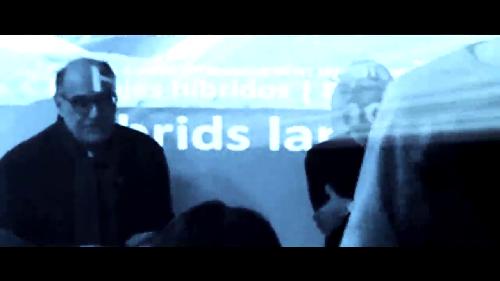
Hybrids Landscapes

Accés obert
1 de gen. 2019
Conferència a càrrec del Professor Daniel Navas (DUOT-TSAB) per el curs Join Studio in Cultural Landscape BCideNtity, X International Workshop. Presentació a càrrec del Professor Miquel Vidal (DUOT - ETSAB).
Organitza Tsinghua University (TU) and Polytechnic University in Catalonia (UPC).
Audio ESP+ ENG
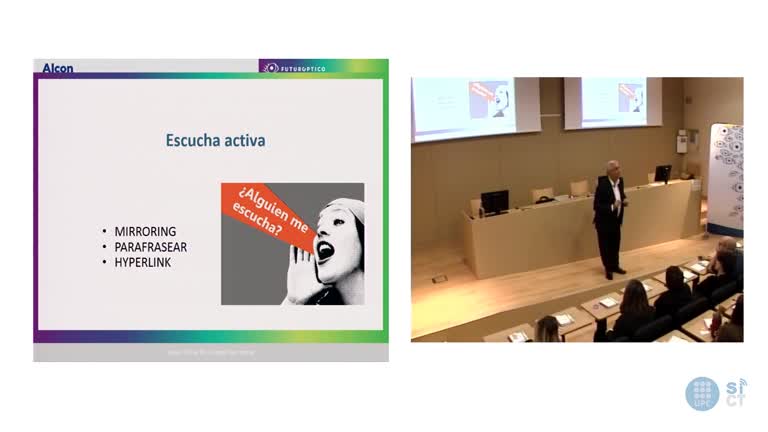
La hibridació sempre ha estat un concepte assimilat a la naturalesa i relacionat amb la
mutació. No obstant això, el pensament paisatgístic que neix a la segona meitat del vuit-
cents, tendeix a construir models identificatius basats en estructures temàtiques tancades.

L'autor ens porta a descobrir el nivell subjacent d'hibridació que transita en els primers i
grans projectes d'intervenció en el paisatge.
La cultura urbana construeix un model antagònic de naturalesa reinventada.

Sobre la infraestructura del verd es construeix un model regeneratiu per a les metròpolis, -
però per sobre d’això- un instrument coherent per articular els amplis paisatges d'una
perifèria cada vegada més valorada. D'aquell paisatgisme que construïa falses ruïnes clàssiques, a aquell altre que reutilitza les
restes arquitectòniques de la memòria industrial desapareguda.

També ens proposa l'autor, una sèrie de pautes per a llegir el territori i entendre la
"hibridesa" que esmorteix la falsa dicotomia entre el sistema urbà i el sistema natural
anterior.

Assenyala com els fragments d'aquesta nova síntesi construeixen una nova capa entre el
sistema simbòlic contemporani i els elements materials. Com aquests acaben finalment
incorporats a la memòria subjectiva de les ciutats. Extrets del seu valor formal com
objectes funcionals o plàstics, per formar part d'una incerta quotidianitat subjectivament
valorada. DANIEL NAVAS

Network geometry

Accés obert
28 de nov. 2018
M. Ángeles Serrano obtained her Ph.D. in Physics at the Universitat de Barcelona (UB) in 1999 with a thesis about gravitational wave detection. In 2000, she also received her Masters in Mathematics for Finance at the CRM-Universitat Autònoma de Barcelona. After four years in the private sector as IT consultant and mutual funds manager, Prof. Serrano returned to academia in 2004 to work in the field of Network Science. Subsequently, she was a researcher at Indiana University (USA), the École Polytechnique Fédérale de Lausanne (Switzerland), IFISC Institute (Spain), and held a Ramón y Cajal research associate appointment at UB until october 2015. The results of her investigations are summarized in major peer reviewed international scientific journals -including Nature, PNAS, PRL, ...-, book chapters, and conference proceedings. Prof. Serrano leads and participates in several research projects at the international and national levels. She is also actively involved in advising and research supervision. She serves in evaluation panels and program scientific committees, and acts as a reviewer in several international journals. In February 2009, she obtained the Outstanding Referee award of the American Physical Society. She is a Founder Member of Complexitat, the Catalan Network for the study of Complex Systems, and a Promoter Member of UBICS, the Universitat de Barcelona Institute of Complex Systems.

Networks are critical to understand human nature ---from genome to brain and society--- and our environment ---the Internet, food webs, international trade... ---, and are changing the way in which we model and predict complex systems in many different disciplines. Surprisingly, all complex networks talk a common language, regardless of their origin, and are imprinted with universal features. They are small-world, strongly clustered and hierarchical, modular, robust yet fragile, and may exhibit unexpected responses like cascades and other critical and extreme events.
Many of these fundamental properties are well explained by a family of hidden metric space network models that led to the discovery that the latent geometry of many real networks is hyperbolic. Hyperbolicity emerges as a result of the combination of popularity and similarity dimensions into an effective distance between nodes, such that more popular and similar nodes have more chance to interact. The geometric approach permits the production of truly cartographic maps of real networks that are not only visually appealing, but enable applications like efficient navigation and the detection of communities of similar nodes. Recently, it has also enabled the introduction of a geometric renormalization group that unravels the multiple length scales coexisting in complex networks, strongly intertwined due to their small world property.

Interestingly, real-world scale-free networks are self-similar when observed at the different resolutions unfolded by geometric renormalization, a property that might find its origin in an evolutionary drive. Practical applications of the geometric renormalization group for networks include high-fidelity downscaled network replicas, a multiscale navigation protocol in hyperbolic space that takes advantage of the increased navigation efficiency at higher scales, and many others.

JIDA'18. Debate de Clausura

Accés obert
23 de nov. 2018
Debat de Clausura del VI Workshop on Educational Innovation in Architecture (JIDA'18) | VI Jornades sobre Innovació Docent en Arquitectura (JIDA '18). 22-23 noviembre. Escuela Técnica Superior de Arquitectura de Zaragoza

JIDA'18. La habitación está vacía y entra el habitante. Seminario de experimentación espacial

Accés obert
23 de nov. 2018
Comunicació a càrrec de Jorge Ramos-Jular. Universidad de Valladolid. Escuela Técnica Superior de Arquitectura.

JIDA'18. Estudiantes de la UVA llevan la arquitectura a colegios y familias de Castilla y León

Accés obert
23 de nov. 2018
Comunicació a càrrec de Gemma Ramón-Cueto. Universidad de Valladolid. Escuela Técnica Superior de Arquitectura.

JIDA'18. Una aproximación a la cooperación desde el Grado de Fundamentos de la Arquitectura

Accés obert
23 de nov. 2018
Comunicació a càrrec de Marcelo Ruiz. Universidad Politécnica de Madrid. Escuela Técnica Superior de Arquitectura.

JIDA'18. Uso docente de la red social "Instagram" en la asignatura de Proyectos 1

Accés obert
23 de nov. 2018
Comunicació a càrrec de María Pura Moreno. Universidad de Cartagena. Departamento de Arquitectura y Tecnología de la Edificación.

JIDA'18. Innovación docente a través de las Tecnologías de la Información y la Comunicación

Accés obert
23 de nov. 2018
Presentació a càrrec de Mª Isabel Alba-Dorado, Universidad de Málaga. Escuela Técnica Superior de Arquitectura.

JIDA'18. Una introducción al urbanismo desde la forma urbana y sus implicaciones medioambientales

Accés obert
23 de nov. 2018
Comunicació a càrrec de Borja Ruiz-Apiláñez. Universidad de Castilla-La Mancha. Escuela de Arquitectura

JIDA'18. Taller de concursos para estudiantes de arquitectura

Accés obert
23 de nov. 2018
Comunicació a càrrec de José María Jové Sandoval. Escuela Técnica Superior de Arquitectura de Valladolid.

JIDA'18. El Máster Habilitante

Accés obert
23 de nov. 2018
Comunicació a càrrec de Marta Serra de l'Escola Tècnica Superior d'Arquitectura Vallés - UPC