

Objectes multimèdia amb l’etiqueta: Matemàtiques i estadística
Resultats de la cerca
Network geometry
Accés obert
28 de nov. 2018
M. Ángeles Serrano obtained her Ph.D. in Physics at the Universitat de Barcelona (UB) in 1999 with a thesis about gravitational wave detection. In 2000, she also received her Masters in Mathematics for Finance at the CRM-Universitat Autònoma de Barcelona. After four years in the private sector as IT consultant and mutual funds manager, Prof. Serrano returned to academia in 2004 to work in the field of Network Science. Subsequently, she was a researcher at Indiana University (USA), the École Polytechnique Fédérale de Lausanne (Switzerland), IFISC Institute (Spain), and held a Ramón y Cajal research associate appointment at UB until october 2015. The results of her investigations are summarized in major peer reviewed international scientific journals -including Nature, PNAS, PRL, ...-, book chapters, and conference proceedings. Prof. Serrano leads and participates in several research projects at the international and national levels. She is also actively involved in advising and research supervision. She serves in evaluation panels and program scientific committees, and acts as a reviewer in several international journals. In February 2009, she obtained the Outstanding Referee award of the American Physical Society. She is a Founder Member of Complexitat, the Catalan Network for the study of Complex Systems, and a Promoter Member of UBICS, the Universitat de Barcelona Institute of Complex Systems.
Networks are critical to understand human nature ---from genome to brain and society--- and our environment ---the Internet, food webs, international trade... ---, and are changing the way in which we model and predict complex systems in many different disciplines. Surprisingly, all complex networks talk a common language, regardless of their origin, and are imprinted with universal features. They are small-world, strongly clustered and hierarchical, modular, robust yet fragile, and may exhibit unexpected responses like cascades and other critical and extreme events.
Many of these fundamental properties are well explained by a family of hidden metric space network models that led to the discovery that the latent geometry of many real networks is hyperbolic. Hyperbolicity emerges as a result of the combination of popularity and similarity dimensions into an effective distance between nodes, such that more popular and similar nodes have more chance to interact. The geometric approach permits the production of truly cartographic maps of real networks that are not only visually appealing, but enable applications like efficient navigation and the detection of communities of similar nodes. Recently, it has also enabled the introduction of a geometric renormalization group that unravels the multiple length scales coexisting in complex networks, strongly intertwined due to their small world property.
Interestingly, real-world scale-free networks are self-similar when observed at the different resolutions unfolded by geometric renormalization, a property that might find its origin in an evolutionary drive. Practical applications of the geometric renormalization group for networks include high-fidelity downscaled network replicas, a multiscale navigation protocol in hyperbolic space that takes advantage of the increased navigation efficiency at higher scales, and many others.
Networks are critical to understand human nature ---from genome to brain and society--- and our environment ---the Internet, food webs, international trade... ---, and are changing the way in which we model and predict complex systems in many different disciplines. Surprisingly, all complex networks talk a common language, regardless of their origin, and are imprinted with universal features. They are small-world, strongly clustered and hierarchical, modular, robust yet fragile, and may exhibit unexpected responses like cascades and other critical and extreme events.
Many of these fundamental properties are well explained by a family of hidden metric space network models that led to the discovery that the latent geometry of many real networks is hyperbolic. Hyperbolicity emerges as a result of the combination of popularity and similarity dimensions into an effective distance between nodes, such that more popular and similar nodes have more chance to interact. The geometric approach permits the production of truly cartographic maps of real networks that are not only visually appealing, but enable applications like efficient navigation and the detection of communities of similar nodes. Recently, it has also enabled the introduction of a geometric renormalization group that unravels the multiple length scales coexisting in complex networks, strongly intertwined due to their small world property.
Interestingly, real-world scale-free networks are self-similar when observed at the different resolutions unfolded by geometric renormalization, a property that might find its origin in an evolutionary drive. Practical applications of the geometric renormalization group for networks include high-fidelity downscaled network replicas, a multiscale navigation protocol in hyperbolic space that takes advantage of the increased navigation efficiency at higher scales, and many others.
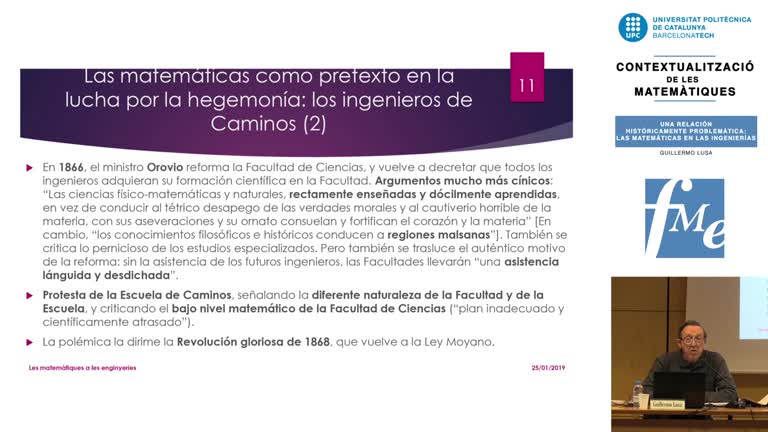
Sobre la docència de les matemàtiques. Curs Kovalevskaya (2018-2019)
Accés obert
6 de nov. 2018
El rector de la Universitat Politècnica de Catalunya, Francesc Torres,i el president del Consell Social, Ramon Carbonell,
presidiran l'acte de reconeixement al professor Pere Pascual, que ha estat guardonat amb el Premi UPC a la Qualitat en la Docència Universitària 2018 en la modalitat de trajectòria docent
presidiran l'acte de reconeixement al professor Pere Pascual, que ha estat guardonat amb el Premi UPC a la Qualitat en la Docència Universitària 2018 en la modalitat de trajectòria docent
Recordando a Sofía Kovalevskaya. Lliçó inaugural Curs Kovalevskaya (2018-2019)
Accés obert
26 de set. 2018
Presentació de l'Any Kovalevskaya a l'FME
Com ja va sent costum des de fa 15 anys, l'FME dedica el curs acadèmic a la figura d'un prestigiós científic. Enguany s'ha triat la matemàtica russa Sofia Kovalevlskaya (Moscou 15 de gener de 1850 - Estocolm 10 de febrer de 1891). Les seves investigacions se centren en l'anàlisi matemàtica, el seu nom ha passat a la història pel Teorema de Cauchy-Kovaleskaya. La seva especialització, per la qual cosa en la seva època va ser coneguda a tot Europa, era la teoria de funcions abelianes. El seu treball sobre els anells de Saturn representa la seva aportació a la matemàtica aplicada. Important també va ser va ser la seva investigació sobre la rotació d'un sòlid al voltant d'un punt fix pel qual va obtenir el Premi Bordin de l'Acadèmia de Ciències de París, així com també va ser la primera dona professora en un centre universitari europeu, a la Universitat d'Estocolm.
La Biblioteca FME fa un recull bibliogràfic i documental del matemàtic del curs per complementar i donar suport a les activitats que la facultat realitza al llarg del curs de cada matemàtic.
Nos acercaremos a la vida y la obra de Sofia Kovalevskaya –matemática, escritora, feminista, nihilista y revolucionaria– a través de lo que otras personas –o ella misma– dijeron de ella. Al estilo del escritor Georges Perec en su libro Je me souviens –Me acuerdo– conoceremos a esta genial mujer a través de citas, de recuerdos de personas que se cruzaron con ella y, en general, la apreciaron y admiraron. Las citas, los extractos de cartas y las palabras en las que nos basaremos provienen de matemáticos, de escritoras y escritores, de científicas y científicos o de familiares que conocieron diferentes facetas de su personalidad.
Com ja va sent costum des de fa 15 anys, l'FME dedica el curs acadèmic a la figura d'un prestigiós científic. Enguany s'ha triat la matemàtica russa Sofia Kovalevlskaya (Moscou 15 de gener de 1850 - Estocolm 10 de febrer de 1891). Les seves investigacions se centren en l'anàlisi matemàtica, el seu nom ha passat a la història pel Teorema de Cauchy-Kovaleskaya. La seva especialització, per la qual cosa en la seva època va ser coneguda a tot Europa, era la teoria de funcions abelianes. El seu treball sobre els anells de Saturn representa la seva aportació a la matemàtica aplicada. Important també va ser va ser la seva investigació sobre la rotació d'un sòlid al voltant d'un punt fix pel qual va obtenir el Premi Bordin de l'Acadèmia de Ciències de París, així com també va ser la primera dona professora en un centre universitari europeu, a la Universitat d'Estocolm.
La Biblioteca FME fa un recull bibliogràfic i documental del matemàtic del curs per complementar i donar suport a les activitats que la facultat realitza al llarg del curs de cada matemàtic.
Nos acercaremos a la vida y la obra de Sofia Kovalevskaya –matemática, escritora, feminista, nihilista y revolucionaria– a través de lo que otras personas –o ella misma– dijeron de ella. Al estilo del escritor Georges Perec en su libro Je me souviens –Me acuerdo– conoceremos a esta genial mujer a través de citas, de recuerdos de personas que se cruzaron con ella y, en general, la apreciaron y admiraron. Las citas, los extractos de cartas y las palabras en las que nos basaremos provienen de matemáticos, de escritoras y escritores, de científicas y científicos o de familiares que conocieron diferentes facetas de su personalidad.
III Jornada Docent del Departament de Matemàtiques
Accés obert
25 de juny 2018
El dimarts 25 de juny de 2018 va tenir lloc la tercera jornada docent del Departament de Matemàtiques de la UPC amb l'objectiu de debatre i reflexionar sobre l'ús de diferents tecnologies en la docència universitària de les Matemàtiques. La jornada compta amb el suport del Departament de Matemàtiques, la Facultat de Matemàtiques i Estadística i l'Institut de Ciències de l'Educació.
Presentació
El Departament de Matemàtiques de la UPC organitza anualment una jornada docent en l’àmbit de les matemàtiques. Aquest any és la terecra edició
Destinataris
Professorat de la UPC i d’altres universitats, especialment aquell que imparteix docència de matemàtiques en enginyeries.
Objectius
Posar en comú la docència de matemàtiques que es fa a la UPC, les seves diferents vessants i l’aplicació de les noves tecnologies per a la millora de l’aprenentatge, els processos d’avaluació, etc.
La Jornada pretén ser un fòrum per al debat sobre la docència de matemàtiques en titulacions universitàries.
Pla de treball
9:45 h Obertura de la Jornada
10:00 - 11:00 h Conferència plenària a càrrec de Pere Pascual (MAT)
11:00 - 11:30 h Pausa - Cafè
11:30 - 12:00 h Presentació dels tallers Ponents: Miquel Ralló (MAT), Joan Trias (MAT), Rodrigo Silveira (MAT), Antoni Susín (MAT)
12:00 - 12:50 h Tallers 1 i 2 Rodrigo Silveira: “Curvas y superficies en JavaScript” Joan Trias: “Il·lustració geomètrica amb GeoGebra. Àlgebra i càlcul multivariable”
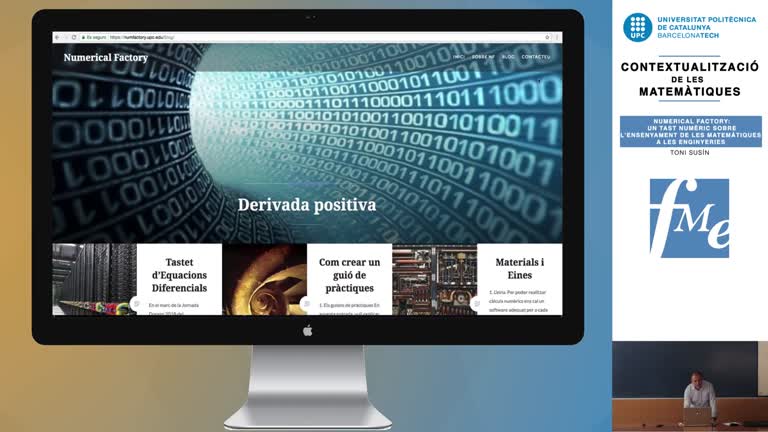
13:00 - 13:50 h Tallers 3 i 4 Miquel Ralló: “Ús de programari en l'aprenentatge de matemàtiques i estadística" Antoni Susín: “Tastet d'Equacions Diferencials a l'estil Numerical Factory”
14:00 h Cloenda de la Jornada
Presentació
El Departament de Matemàtiques de la UPC organitza anualment una jornada docent en l’àmbit de les matemàtiques. Aquest any és la terecra edició
Destinataris
Professorat de la UPC i d’altres universitats, especialment aquell que imparteix docència de matemàtiques en enginyeries.
Objectius
Posar en comú la docència de matemàtiques que es fa a la UPC, les seves diferents vessants i l’aplicació de les noves tecnologies per a la millora de l’aprenentatge, els processos d’avaluació, etc.
La Jornada pretén ser un fòrum per al debat sobre la docència de matemàtiques en titulacions universitàries.
Pla de treball
9:45 h Obertura de la Jornada
10:00 - 11:00 h Conferència plenària a càrrec de Pere Pascual (MAT)
11:00 - 11:30 h Pausa - Cafè
11:30 - 12:00 h Presentació dels tallers Ponents: Miquel Ralló (MAT), Joan Trias (MAT), Rodrigo Silveira (MAT), Antoni Susín (MAT)
12:00 - 12:50 h Tallers 1 i 2 Rodrigo Silveira: “Curvas y superficies en JavaScript” Joan Trias: “Il·lustració geomètrica amb GeoGebra. Àlgebra i càlcul multivariable”
13:00 - 13:50 h Tallers 3 i 4 Miquel Ralló: “Ús de programari en l'aprenentatge de matemàtiques i estadística" Antoni Susín: “Tastet d'Equacions Diferencials a l'estil Numerical Factory”
14:00 h Cloenda de la Jornada
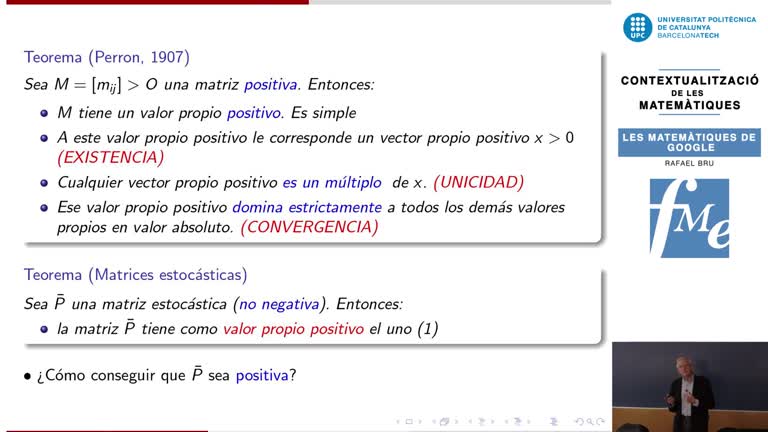
Les Matemàtiques de Google. (Contextualització de les Matemàtiques a les carreres tecnològiques de la UPC)
Accés obert
23 de maig 2018
The level set method for motion by mean curvature
Accés obert
18 de maig 2018
Tobias Colding, born in Copenhagen, received his Ph.D. in 1992 at the University of Pennsylvania under Chris Croke. Since 2005 Colding has been a professor of mathematics at MIT. He was on the faculty at the Courant Institute of New York University in various positions from 1992 to 2008.
In the early stage of his career, Colding did impressive work on manifolds with bounds on Ricci curvature. In 1998, he gave an invited address to the ICM in Berlin. He began coauthoring with William P. Minicozzi at this time: first on harmonic functions and later on minimal surfaces. In 2010 Tobias H. Colding received the Oswald Veblen Prize in Geometry together with William Minicozzi II for their profound work on minimal surfaces.
Since 2008 he has been a Fellow of the American Academy of Arts and Sciences, and since 2006 a foreign member of the Royal Danish Academy of Sciences and Letters, and also since 2006 an honorary professor of University of Copenhagen, Denmark.
Many physical phenomema lead to tracking moving fronts whose speed depends on the curvature. The "level set method" has been tremendously succesful for this, but the solutions are typically only continuous. We will discuss results that show that the level set flow has twice differentiable solutions. This is optimal. These analytical questions crucially rely on understanding the underlying geometry. The proofs draws inspiration from real algebraic geometry and the theory of analytical functions.
In the early stage of his career, Colding did impressive work on manifolds with bounds on Ricci curvature. In 1998, he gave an invited address to the ICM in Berlin. He began coauthoring with William P. Minicozzi at this time: first on harmonic functions and later on minimal surfaces. In 2010 Tobias H. Colding received the Oswald Veblen Prize in Geometry together with William Minicozzi II for their profound work on minimal surfaces.
Since 2008 he has been a Fellow of the American Academy of Arts and Sciences, and since 2006 a foreign member of the Royal Danish Academy of Sciences and Letters, and also since 2006 an honorary professor of University of Copenhagen, Denmark.
Many physical phenomema lead to tracking moving fronts whose speed depends on the curvature. The "level set method" has been tremendously succesful for this, but the solutions are typically only continuous. We will discuss results that show that the level set flow has twice differentiable solutions. This is optimal. These analytical questions crucially rely on understanding the underlying geometry. The proofs draws inspiration from real algebraic geometry and the theory of analytical functions.
Melocotón en Almíbar. Curs Hilbert (2017-2018)
Accés obert
17 de maig 2018
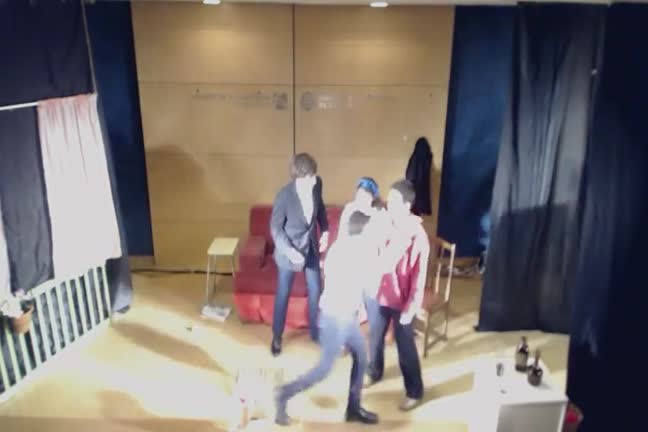
La Companyia FEM TEATRE FME premiada de nou en el marc dels VI premis de Teatre Universitari de Barcelona: Premis a milor actriu protagonista i millor producción per ‘Melocotón en almíbar' i a la mejor actriu (ex-aequo) i millor cartell per la 'La sirena varada'.
Dijous 17 a les 16.00h Melocotón en Almíbar de Miguel Mihura
Paula Barja - Nuria
Sofía Cárdenas - Wanda
Oriol Navarro - Federico
Ferran López - Carlos
Soraya Sánchez - Doña Pilar
Ernesto Lanchares - Sor María
Andreu Tomàs - Suárez
Dijous 17 a les 16.00h Melocotón en Almíbar de Miguel Mihura
Paula Barja - Nuria
Sofía Cárdenas - Wanda
Oriol Navarro - Federico
Ferran López - Carlos
Soraya Sánchez - Doña Pilar
Ernesto Lanchares - Sor María
Andreu Tomàs - Suárez
